
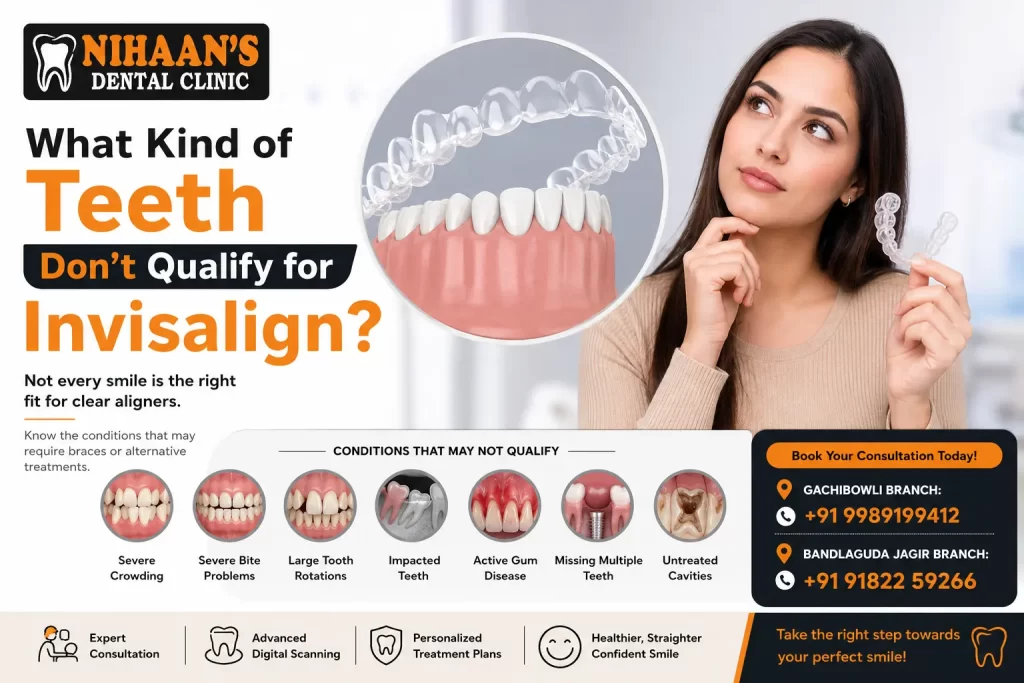
If you’re considering Invisalign to straighten your teeth, one of the first questions you may ask is: “What kind of teeth don’t qualify for Invisalign?”
The good news is that Invisalign can treat a wide range of orthodontic problems. However, not every case is suitable for clear aligners alone. Some complex dental conditions may require braces, surgery, or a combination of treatments for the best long-term results.
Understanding whether you’re a suitable candidate can save time, avoid unrealistic expectations, and help you choose the most effective treatment from the beginning.
At Nihaan’s Dental Clinic, we evaluate every patient’s bite, jaw alignment, oral health, and treatment goals before recommending Invisalign or alternative orthodontic solutions.
- Personalized Invisalign Assessment
- Digital Smile Analysis
- Transparent Treatment Recommendations
- Flexible Appointment Scheduling
Book your Invisalign assessment today and get expert guidance based on your smile—not guesswork.
What Kind of Teeth Don’t Qualify for Invisalign?
You may not qualify for Invisalign alone if you have:
- Severe jaw misalignment (skeletal bite issues)
- Extremely crowded teeth
- Large gaps requiring complex tooth movement
- Impacted teeth
- Significant tooth rotations (usually over 45 degrees)
- Teeth that need vertical movement (intrusion or extrusion)
- Advanced gum disease
- Loose teeth caused by bone loss
- Multiple missing teeth affecting bite stability
- Poor oral hygiene or untreated cavities
Many of these conditions can still be treated—but often after additional dental procedures or with traditional braces instead of Invisalign.
How Does Invisalign Work?
Invisalign uses a series of custom-made, transparent aligners that gradually move teeth into better alignment.
Each aligner is worn for approximately 20–22 hours daily and replaced every one to two weeks as your teeth shift.
The treatment works exceptionally well for:
- Mild crowding
- Mild to moderate spacing
- Minor bite corrections
- Relapse after previous braces
- Cosmetic smile improvements
However, its effectiveness depends on the complexity of your dental condition.
Dental Conditions That May Not Qualify for Invisalign
1. Severe Crowding
When teeth overlap significantly due to limited jaw space, Invisalign may not generate enough force for predictable movement.
Patients with severe crowding often require:
- Tooth extraction
- Traditional braces
- Expansion techniques
Once sufficient space is created, Invisalign may sometimes be used during the finishing phase.
2. Severe Bite Problems
Complex bite issues include:
- Severe overbite
- Severe underbite
- Crossbite involving multiple teeth
- Open bite caused by skeletal problems
Although Invisalign has advanced considerably, major skeletal discrepancies frequently require orthodontic braces, jaw surgery, or a combined treatment plan.
3. Large Tooth Rotations
Teeth that have rotated significantly—especially canines and premolars—can be difficult to reposition using aligners alone.
Traditional braces often provide better control for these movements.
4. Impacted Teeth
An impacted tooth remains trapped beneath the gums or bone and cannot erupt naturally.
Common examples include impacted:
- Canines
- Wisdom teeth
These cases typically require surgical exposure and orthodontic traction before Invisalign becomes an option.
5. Significant Vertical Tooth Movement
Some teeth need to move:
- Upward (intrusion)
- Downward (extrusion)
These movements are among the most technically challenging with clear aligners and often respond better to fixed braces.
6. Missing Multiple Teeth
If several teeth are missing, Invisalign alone cannot restore proper bite function.
Treatment may involve:
- Dental implants
- Bridges
- Crowns
- Orthodontic planning
A comprehensive restorative approach is often required.
7. Active Gum Disease
Healthy gums are essential before orthodontic treatment begins.
Patients with:
- Bleeding gums
- Bone loss
- Periodontal disease
- Tooth mobility
should first receive periodontal treatment.
Moving unhealthy teeth can worsen damage and increase the risk of tooth loss.
8. Untreated Tooth Decay
Before Invisalign starts, dentists generally treat:
- Cavities
- Cracked teeth
- Root canal infections
- Broken fillings
Healthy teeth provide a stable foundation for orthodontic movement.
Can Invisalign Treat Complex Cases Today?
Yes—far more than it could a decade ago.
Modern Invisalign technology now manages many cases that previously required braces, including:
- Moderate crowding
- Moderate overbite
- Crossbite
- Deep bite
- Mild open bite
Advanced treatment planning, attachments, elastics, and digital scanning have expanded Invisalign’s capabilities considerably. However, every case requires an individual clinical assessment.
Invisalign vs Traditional Braces: Which Is Better?
| Condition | Invisalign | Traditional Braces |
| Mild crowding | ✅ Excellent | ✅ Excellent |
| Moderate crowding | ✅ Good | ✅ Excellent |
| Severe crowding | ⚠️ Sometimes | ✅ Best |
| Severe bite correction | ⚠️ Limited | ✅ Best |
| Tooth rotations | ⚠️ Moderate | ✅ Excellent |
| Impacted teeth | ❌ Usually No | ✅ Preferred |
| Comfort | ✅ Excellent | Moderate |
| Appearance | ✅ Nearly Invisible | Visible |
| Oral hygiene | Easier | More difficult |
Invisalign offers outstanding cosmetic and comfort benefits, while braces remain the preferred option for certain highly complex orthodontic problems.
How Much Does Invisalign Cost in Hyderabad?
The cost depends on:
- Complexity of the case
- Number of aligners required
- Treatment duration
- Experience of the dentist
- Whether refinements are needed
The cost of Invisalign depends on your specific case—not just the type of aligners. After a detailed examination, we’ll provide a personalized treatment plan with clear pricing and available payment options.
Contact Nihaan’s Dental Clinic today for a customized Invisalign consultation and cost estimate.
Common Mistakes People Make Before Choosing Invisalign
Many patients assume Invisalign is suitable for everyone, but these common mistakes can affect treatment success:
- Choosing Invisalign without a proper orthodontic evaluation
- Comparing only the price instead of treatment quality
- Ignoring gum health before starting treatment
- Not wearing aligners for the recommended 20–22 hours daily
- Expecting faster results than clinically possible
- Selecting providers with limited Invisalign experience
A personalized treatment plan is always more valuable than a one-size-fits-all approach.
Why a Professional Assessment Matters
Even if your teeth appear only slightly crooked, hidden issues such as bite imbalance, jaw discrepancies, or periodontal disease may influence treatment.
A comprehensive consultation typically includes:
- Digital oral examination
- Bite analysis
- X-rays
- Intraoral scans
- Smile assessment
- Discussion of treatment goals
This helps determine whether Invisalign, braces, or another approach is the safest and most effective option.
Why Patients in Gachibowli and Bandlaguda Jagir Choose Nihaan’s Dental Clinic
For patients searching:
- Invisalign near Gachibowli
- Best Invisalign dentist in Hyderabad
- Clear aligners near Bandlaguda Jagir
- Invisalign consultation in Hyderabad
Nihaan’s Dental Clinic provides:
- Personalized orthodontic evaluations
- Digital smile planning
- Invisalign treatment for eligible cases
- Alternative orthodontic solutions when appropriate
- Transparent treatment recommendations
- Patient-focused care with modern dental technology
Every treatment recommendation is based on clinical suitability rather than offering the same solution to every patient.
See why patients trust Nihaan’s Dental Clinic. Read our Google Reviews and book your consultation today
Should You Choose Invisalign?
If you’re wondering whether Invisalign is right for you, focus on your diagnosis rather than the appearance of your teeth alone.
Choose Invisalign if:
- You have mild to moderate alignment issues.
- You can wear aligners consistently for 20–22 hours a day.
- You prefer a discreet orthodontic solution.
Consider braces or combined treatment if:
- You have severe bite or jaw problems.
- Your teeth require complex movements.
- You have untreated gum disease or extensive dental issues.
The best decision starts with a detailed examination by an experienced dentist who can explain all suitable options based on your specific needs—not just recommend the most popular treatment.
Conclusion
The answer to “What kind of teeth don’t qualify for Invisalign?” is more than a simple yes or no. While modern Invisalign systems can successfully treat many orthodontic concerns, severe crowding, complex bite issues, impacted teeth, active gum disease, and certain jaw discrepancies may require alternative treatment approaches.
If you’re considering Invisalign in Gachibowli or Bandlaguda Jagir, Hyderabad, a comprehensive consultation at Nihaan’s Dental Clinic can help determine the safest and most effective solution for your smile. An individualized treatment plan ensures you receive care that delivers long-term function, aesthetics, and oral health.
Frequently Asked Questions
No. While many adults and teenagers qualify, severe orthodontic or skeletal issues may require braces or combined treatment.
It depends on your condition. Invisalign offers excellent aesthetics and comfort, while braces often perform better in highly complex tooth movements.
Many can, but severe crowding, impacted teeth, or complex bite issues may require alternative orthodontic treatments.
The only reliable way is through a professional orthodontic consultation that includes digital scans and bite evaluation.
Most patients experience mild pressure for a few days after changing aligners, but it is generally less uncomfortable than traditional braces.
Treatment usually ranges from 6 to 24 months, depending on the complexity of your case and how consistently you wear the aligners.