
Last Updated: 12|11|2026 verified by Nihaans Dental Clinic Team
Tooth pain, deep cavities or dental infections can leave you wondering whether your tooth can be saved or needs to be removed. If your dentist has suggested Root Canal Treatment (RCT) or tooth extraction, you may be unsure which option is better.
In most cases, saving your natural tooth with root canal treatment is preferred when the tooth can be predictably restored. However, tooth extraction may be necessary when the tooth is severely damaged, fractured or cannot be restored successfully.
Both treatments address dental problems, but they have different purposes, procedures and long-term considerations.
At Nihaans Dental, Hyderabad, we believe patients should understand their treatment options before making a dental decision. This guide explains root canal treatment versus tooth extraction, including their differences, benefits, costs, recovery and situations where each may be recommended.
1. What Is Root Canal Treatment?
Root Canal Treatment (RCT), also called endodontic treatment, is a dental procedure used to treat infection or inflammation inside a tooth.
Every tooth contains a soft tissue called dental pulp, which consists of nerves, blood vessels and connective tissue. Deep tooth decay, cracks, trauma or repeated dental procedures can damage this pulp and cause infection.
Common signs of possible pulp infection include: To know more check from our Root Canal Treatment
2. What Is Tooth Extraction?
Tooth extraction is a dental procedure in which a tooth is removed from its socket in the jawbone.
Extraction may be recommended when a tooth is severely damaged, extensively decayed, fractured beyond repair or affected by certain advanced dental conditions.
There are two common types of tooth extraction:
Simple Extraction: The dentist removes a visible tooth using appropriate dental instruments.
Surgical Extraction: This may be necessary when a tooth is broken, impacted or difficult to access. A small incision in the gum may be required.
Benefits of Tooth Extraction
- Removes a tooth that cannot be predictably restored.
- Helps manage certain dental infections when removal is necessary.
- Addresses problems associated with severely damaged or impacted teeth.
- Provides an opportunity to plan tooth replacement when appropriate.
However, extracting a permanent tooth creates a gap. Depending on its position and your oral health, your dentist may discuss replacement options such as dental implants, bridges or dentures.
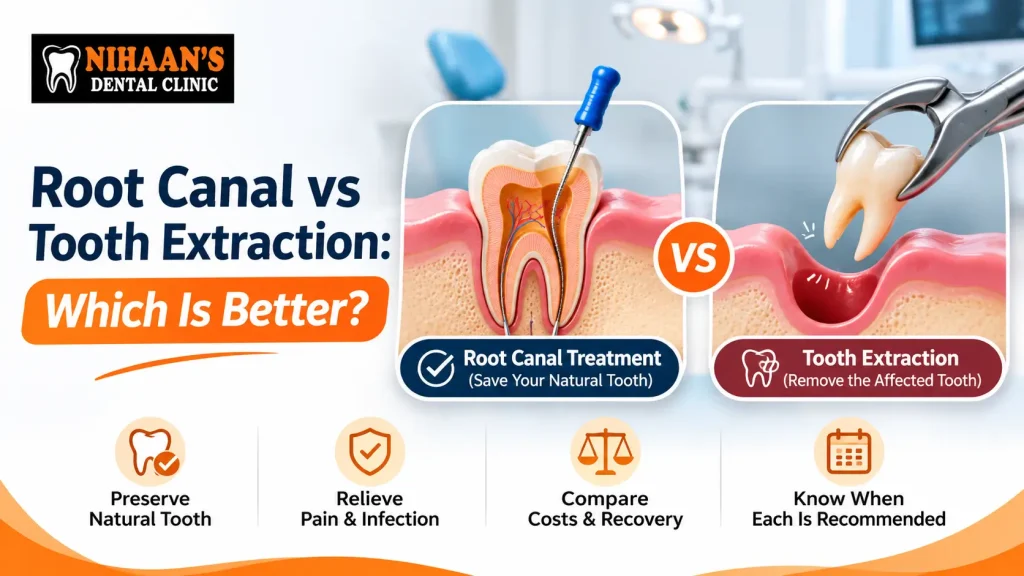
3. Root Canal vs Tooth Extraction: Key Differences
Understanding the differences can help you make a more informed decision with your dentist.
| Factor | Root Canal Treatment | Tooth Extraction |
|---|---|---|
| Main purpose | Preserve the natural tooth | Remove the affected tooth |
| Tooth structure | Retained and restored | Completely removed |
| Procedure | Cleans and seals root canals | Removes tooth from socket |
| Anaesthesia | Usually local anaesthesia | Usually local anaesthesia |
| Recovery | Initial tenderness may occur | Extraction socket needs healing |
| Tooth replacement | Usually unnecessary | May be considered |
| Long-term care | Restoration and dental check-ups | Site monitoring and replacement care if needed |
Which Treatment Is Better?
If your natural tooth has sufficient healthy structure, adequate supporting tissues and a predictable restorative outcome, root canal treatment is generally preferred.
If the tooth has a severe fracture, extensive damage or inadequate supporting structures, extraction may be the more appropriate option.
The final decision should be based on a clinical examination, dental imaging when indicated and an assessment of the tooth’s restorability.
4. When Can a Tooth Be Saved With Root Canal Treatment?
Root canal treatment may be recommended when the pulp is irreversibly inflamed or infected, but the remaining tooth can still be restored.
Some common situations include: You can learn from our post – Click here further reading
5. When Is Tooth Extraction Necessary?
Although preserving natural teeth is generally desirable, not every tooth can be saved successfully.
Your dentist may recommend extraction in situations such as:
Severely Damaged Tooth
If insufficient healthy tooth structure remains to support a suitable restoration, extraction may offer a more predictable outcome.
Vertical Root Fracture
A fracture extending vertically along the root can make a tooth unsuitable for predictable restoration.
Advanced Gum Disease
Severe periodontal disease can cause substantial loss of the bone and tissues supporting the tooth. If the tooth has a poor prognosis, extraction may be necessary.
Unsuccessful Previous Treatment
Sometimes a tooth that has undergone root canal treatment cannot be predictably saved through retreatment or endodontic surgery.
Problematic Impacted Teeth
Certain impacted teeth, particularly wisdom teeth, may need removal when they cause repeated infection, damage to neighbouring teeth or other complications.
Extraction should be recommended after considering all reasonable treatment options, including whether the tooth can be restored.
6. Is Saving Your Natural Tooth Better?
In many situations, yes.
Natural teeth are designed to work together for chewing, speaking and maintaining your bite. When a tooth can be predictably restored, preserving it generally offers important functional advantages.
Here is why dentists often prefer saving a natural tooth:
Maintains Natural Chewing Function: A successfully treated and restored tooth can continue supporting normal chewing.
Preserves Tooth Position: Keeping your natural tooth helps maintain the existing arrangement of neighbouring teeth.
Avoids Additional Replacement Procedures: You may not need a separate implant, bridge or denture to replace the tooth.
Maintains Natural Appearance: A suitable restoration can be designed to blend with the surrounding teeth.
However, saving a tooth is not always the best option. If its long-term prognosis is poor, extraction followed by an appropriate replacement plan may be more suitable.
7. Root Canal vs Extraction: Cost Comparison
Cost is an important consideration when choosing between root canal treatment and extraction.
However, comparing only the immediate procedure cost may not give you the complete picture.
Root Canal Treatment Cost
The cost of RCT depends on:
- Which tooth requires treatment.
- The number and complexity of root canals.
- The severity of infection.
- Whether retreatment is required.
- Whether a dental crown or additional restoration is needed.
Tooth Extraction Cost
Extraction costs may vary depending on:
- Whether it is a simple or surgical extraction.
- The position of the tooth.
- The complexity of the procedure.
- Whether additional treatment is necessary.
What About Tooth Replacement Costs?
If a permanent tooth is extracted, replacement options may include:
- Dental implants.
- Dental bridges.
- Removable partial dentures.
Each option has different costs, treatment timelines and maintenance requirements.
For example, dental implant treatment may involve additional assessment, surgery, healing and restoration appointments.
Therefore, it is important to compare the complete treatment plan rather than just the initial extraction or RCT cost.
At Nihaans Dental, patients can discuss suitable treatment options and associated costs following an individual dental assessment.
8. Recovery After Root Canal and Tooth Extraction
Both treatments involve a recovery period, but the healing process is different.
Recovery After Root Canal Treatment
Some patients experience mild tenderness or discomfort for a few days following RCT, particularly while chewing.
Helpful aftercare practices include:
- Avoid chewing hard foods on the treated tooth until it is properly restored.
- Follow your dentist’s instructions.
- Maintain regular brushing and flossing.
- Attend recommended follow-up appointments.
- Get the recommended permanent filling or crown.
Recovery After Tooth Extraction
After extraction, the body needs time to heal the empty socket.
Your dentist may recommend:
- Biting gently on gauze as instructed.
- Avoiding vigorous rinsing during the initial healing period.
- Avoiding smoking and drinking through a straw during early healing.
- Eating soft foods initially.
- Keeping the extraction area clean as advised.
- Following prescribed medication instructions.
Healing time varies depending on the complexity of the extraction and individual health factors.
Contact your dentist if you experience worsening pain, persistent bleeding, increasing swelling or fever.
9. What Happens If You Don’t Replace a Missing Tooth?
After removing a permanent tooth, you may wonder whether replacing it is necessary.
The answer depends on the location of the missing tooth, your bite, surrounding teeth and overall oral health.
Possible consequences of an unreplaced missing tooth include:
- Shifting of neighbouring teeth into the empty space.
- Changes in the way upper and lower teeth meet.
- Difficulty chewing certain foods.
- Over-eruption of the opposing tooth in some cases.
- Changes in the jawbone in the area where the tooth was removed.
Not every missing tooth requires immediate replacement. Your dentist can evaluate whether a dental implant, bridge, denture or observation is appropriate.
If you are considering tooth replacement, explore the dental treatment options at Nihaans Dental.
What Should You Ask Your Dentist Before Deciding?
If you have been advised to undergo extraction, consider asking:
- Can my natural tooth still be saved?
- Would root canal treatment be a suitable option?
- Will I need a crown after RCT?
- What is the long-term prognosis of saving this tooth?
- If extraction is necessary, what are my replacement options?
- What would the complete treatment cost and timeline be?
Understanding these answers can help you make an informed decision.
Why Choose Nihaans Dental in Hyderabad?
At Nihaans Dental, we believe dental treatment should begin with understanding the patient’s condition and explaining suitable options.
Our patient-focused approach includes:
- Individualised dental treatment planning.
- Modern dental techniques and equipment.
- Clear explanations of available treatment options.
- Attention to patient comfort.
- Follow-up guidance and preventive dental care.
Whether you need root canal treatment or tooth extraction, an appropriate diagnosis is the first step towards making an informed decision.
If you are looking for Root Canal Treatment in Hyderabad, our team can assess your dental condition and discuss suitable treatment options.
Frequently Asked Questions
When a tooth can be predictably restored, root canal treatment is generally preferred because it preserves your natural tooth. Extraction may be necessary when the tooth is severely damaged or cannot be restored successfully.
Both procedures are generally performed under local anaesthesia. You may experience pressure during treatment and temporary discomfort afterward. The experience varies depending on the condition of the tooth and individual sensitivity.
Extraction removes the affected tooth, but it may create a need for additional treatment. Depending on the location of the missing tooth, you may need to consider an implant, bridge or denture.
A root canal-treated tooth can function for many years with appropriate restoration and regular dental care. Its longevity depends on the remaining tooth structure, quality of restoration, oral hygiene and individual factors. No treatment can guarantee a lifetime result.
If an infected or irreversibly inflamed tooth is left untreated, the condition may worsen and lead to increased pain, swelling or an abscess. In some cases, the tooth may eventually become impossible to save.
Sometimes. The possibility depends on the condition of the root, remaining tooth structure, surrounding bone and extent of infection. Your dentist can determine whether RCT or another treatment is suitable.
A crown is often recommended for back teeth because they experience significant chewing forces. Whether a crown is necessary depends on the tooth’s remaining structure and the type of restoration required.
Yes. Dental implants may be considered after extraction depending on bone health, healing, medical history and other clinical factors. Your dentist will advise you on the appropriate timing.
Looking for Root Canal Treatment in Hyderabad?
Experiencing tooth pain or wondering whether your tooth can be saved?
Visit Nihaans Dental, Hyderabad, for a dental consultation and personalised treatment assessment.
Our team can evaluate your tooth, explain suitable treatment options and help you make an informed decision about your oral health.
Book Your Consultation Today at Nihaans Dental.
References and Further Reading
These sources support the medical information in the article: